
“Pagan cultures celebrated Winter Solstice and the hope of spring by decorating with evergreen branches Christians later adapted the tradition, using Christmas trees. The triangular shape of a fir tree symbolized the Trinity, and the earliest Christmas trees were often decorated with gingerbread, apples, or candles.” ~ Christmas Agriculture Facts
Christmas Ag Facts: Yew Trees

“Queen Charlotte (wife of George III) decorated a single yew branch with ribbons and candles, introducing tradition of Christmas trees to Great Britain. Because the Yew tree can put forth new shoots, some trees live hundreds of years. Because of that, in some cultures, the Yew represents eternal life.” ~ Christmas Agriculture Facts
Christmas Ag Facts: Pine Cones
“According to Sicilian folklore, giving pine cones represented wishing one good health and good luck. Today, many use pine cones for decorating during the holiday season.” ~ Christmas Agriculture Facts
Christmas Ag Facts: Cranberries
“Among many cultures, cranberries symbolize abundance and gratitude. Due to the timing of their harvest (late autumn), they became a staple at holiday meals and were often strung together to create garlands at Christmastime.” ~ Christmas Agriculture Facts
Christmas Ag Facts: Wheat
“An ancient Hungarian custom is to offer sprouts of wheat to the holy infant in the manger, because wheat represents sustenance, prosperity, and renewal or new life.” ~ Christmas Agriculture Facts
Christmas Ag Facts: The Christmas Rose

“The Helleborus flower, or Christmas Rose, was believed to possess magical powers because it blooms in cold weather. According to some legends, if the plant blooms before Christmas, expect a bountiful year ahead.” ~ Christmas Agriculture Facts
Christmas Ag Facts: Radishes
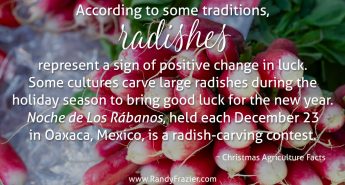
“According to some traditions, radishes represent a sign of positive change in luck. Some cultures carve large radishes during the holiday season to bring good luck for the new year. Noche de Los Rábanos, held each December 23 in Oaxaca, Mexico, is a radish-carving contest.” ~ Christmas Agriculture Facts
Christmas Ag Facts: Mistletoe
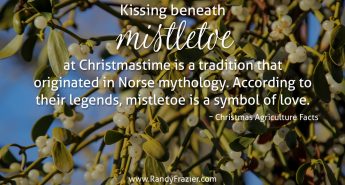
“Kissing beneath mistletoe at Christmastime is a tradition that originated in Norse mythology. According to their legends, mistletoe is a symbol of love.” ~ Christmas Agriculture Facts

 Address:
(Home Office)
29 Underwood Road,
Wye Mountain/
Bigelow, AR 72016
Address:
(Home Office)
29 Underwood Road,
Wye Mountain/
Bigelow, AR 72016 Email: